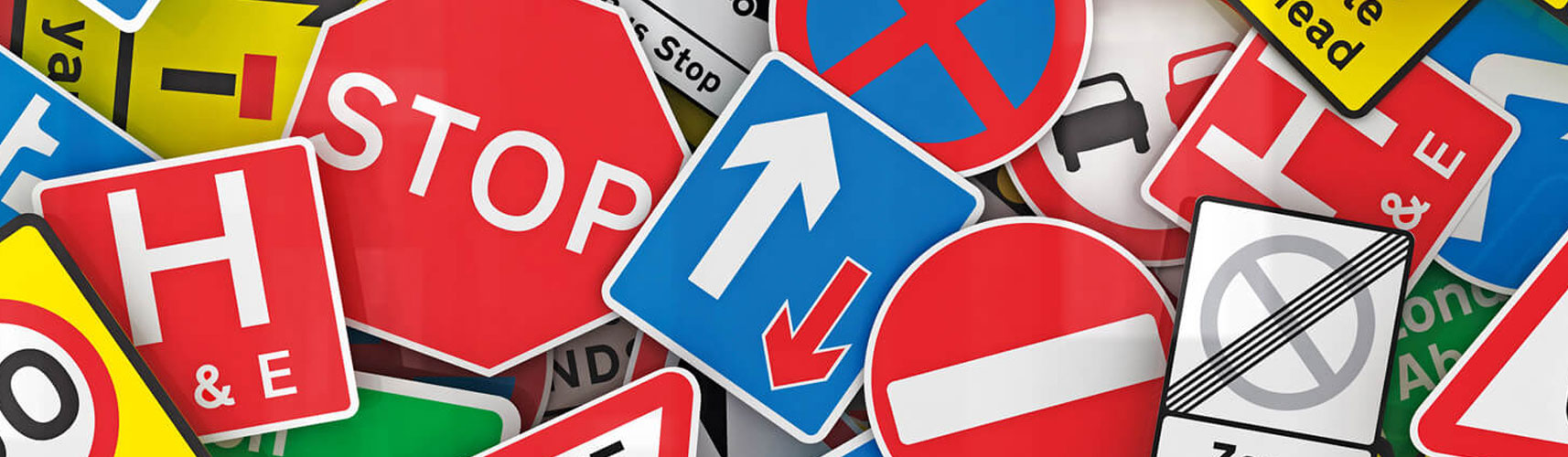

Road safety laws you may not know

When it comes to driving and road safety, you might think that you’re completely in the know regarding what is legal and what is decidedly illegal. However, while it’s common knowledge that you shouldn’t overstep the speed limit, stop at red traffic lights and stay on the left side of the road, there are also several lesser-known laws that the average motorist may be unaware of.

Here are some laws related to driving and road safety that you may not know:

It’s illegal to smoke in a car if a child is present

While many smokers feel slightly aggrieved that their freedom to smoke in public has been restricted in recent years, they take comfort in being able to light one up while on their daily commute. However, even though these smokers are allowed to smoke in a vehicle if they’re on their own or in the presence of adults, they are not allowed to smoke if children are in the car. This is according to Section 2(1)(a)(iii) of the Tobacco Products Control Act, 1993, which states that “no person may smoke any tobacco product in any motor vehicle when a child under the age of 12 years is present in that vehicle.” There is also quite a hefty penalty to pay for breaking this law, with a R500 fine imposed.

Undertaking unlawful towing

You might think as soon as you get your licence that you have carte blanche when it comes to towing your car. However, you would be wrong to assume that, as with a regular driver’s licence (Code B), you are only permitted to tow trailers lighter than 750 kilograms. Should you want to tow a trailer heavier than that, you will need to be in possession of a Code EB licence.

Warning other motorists about roadblocks

It’s become a trend lately for motorists to “look out for each other” and subtly alert fellow drivers to roadblocks by either flashing their lights or even posting messages on social media. This seemingly innocent action could mean though that you run afoul of the law, especially as roadblocks are primarily intended to snare wanted criminals. By alerting other motorists to roadblocks, you could be seen as ben an accomplice to a criminal.

Using a cell phone while driving

Many motorists are still unaware that they are not allowed to use their cell phones at all while driving and will often take chances with their mobile devices on the roads. In actual fact though, the South African National Road Traffic Act prohibits all activities related to a cell phone while driving, with a fine up to R750 that can be imposed if caught in the act. This law recognises that many accidents are often the cause of distracted drivers who are either speaking on their phone or sending text messages.

You can’t transport children in the back of a bakkie for money

On 11 May 2017, a new law came into effect prohibiting the transportation of schoolchildren (for compensation) in the goods compartment of a bakkie. This law was devised in order to address the “bakkie-taxis”, whereby drivers are compensated for transporting children in bakkies in rural areas, as this is often the only way they can get to school. If you’re brave enough to take on this law, you’ll be on the receiving end of a R2,500 when the vehicle is confiscated. Additionally, you’ll have to pay a R7,000 fine to release the impounded vehicle on the first offence, a R10 000 fine to on the second offence, and a R15,000 fine on the third offence.

Once you’re fully aware of your rights on the road, make sure that you protect your precious vehicle by getting a tracking device from Cartrack. Contact us today to find out more.


How fleet management can improve road safety

Road safety is one of the gravest concerns for South African motorists, with statistics from the Road Traffic Management Corporation (RTMC) annual road death statistics revealing that from January to December 2016 shows that 14,071 people died on South African roads, a 9% increase on the 2015 figure of 12,944.

One of the best ways to counter this trend is to implement fleet management practices that can help ensure that your vehicles and drivers are kept safe on the roads. In particular, it is beneficial to invest in vehicle telematics, which refers to the tracking and diagnostics of vehicles.

Through either a GPS system or a cellular triangulation platform, fleet managers can track the journeys of their vehicles and the actions taken during the course of a day by their drivers. Precise data can also be extracted from driver’s trips from the tracking system and onboard. Subsequently, fleet managers can identify areas in which their drivers are not following the rules of the road and endangering both their lives and the lives of other motorists. This data can include:

Engine speed management

Fleet managers can better manage how their engine is performing with information provided on the engine’s Rev’s Per Minute (RPMs). Subsequent mediation with drivers will help to prevent this behaviour and result in improved and therefore safer performance from vehicles within a fleet.

Speeding Reports

This report provides a clear indication how often drivers in a fleet exceed the legal speed limit on their routes. Customers can also pre-determine a maximum speed for their drivers, and duly receive reports related to when they exceed this speed limit. This function enables fleet managers to control over-speeding drivers and prevent potential accidents.

Fuel Consumption

Data can be provided relating to fuel consumption with the intention of improving fuel management, receiving details on fuel consumption and Co2 emissions. Better fuel management not only saves costs, but also ensures that drivers are less likely to run out of fuel on long trips, thereby preventing unnecessary mishaps related to fuel shortages or loss.

Route profile and difficulty

Information can be provided on variables relating to the route that the driver has taken, including the total distance driven, the total ascent and descent and the average uphill and downhill gradient. More information is also provided on actions that the driver has taken during the route, including accelerator and brake pedal frequency, gear change frequency and the average speed recorded. Providing drivers with remedial guidance in relation to these actions will result in better driving behaviour on the roads.

When it comes to fleet management, nobody does it better than Cartrack. Through dedicated GPS monitoring, Cartrack clients are always aware of their fleet’s activity. Customers can locate all the vehicles in their fleet, accurately shown on our web-based street-level map, in real-time. Clients can use their PC or smartphone to monitor their fleet, with no additional software required.

Petrol price surges towards a record R16 a litre

South African drivers are going to have to brace tight, as the Automobile Association (AA) has forecasted that the petrol price could be hiked up to 85 cents per litre in June, while the diesel price could increase by 87 cents a litre and illuminating paraffin will be 82 cents per litre more expensive. Even more shockingly, it’s possible that the price could even rise to R17 a litre in July.

There are several factors causing these shocking increases, but the main cause is the volatile oil price and the country’s fluctuating exchange rate. Political uncertainty surrounding Iran, OPEC and a trade war started by US president Donald Trump are all contributing to the increased oil price, while the weakening of the rand compared to earlier this year has also not helped.

It’s worth noting that R7,50 of the fuel price is fixed; the rest of the price can be attributed to extraneous costs such as fuel levies (R3,50), the Road Accident Fund (R2) and transport and distribution costs.

To try soften the blow of this news, here are some tips on how to save petrol:

  • Only use the heater when necessary
  • Don’t accelerate to red lights
  • Don’t speed unnecessarily
  • Don’t use the clutch unnecessarily
  • Don’t drive in the incorrect gear
  • Don’t overload your vehicle with unnecessary objects
  • Make sure that you service and maintain your vehicle to increase fuel efficiency
  • Don’t idle in traffic
  • Make sure that you plan your route properly and don’t get lost

If you happen to manage a large fleet, Cartrack can help you save fuel in your business with our fuel monitoring product. Click here to find out more.

How to prepare your vehicle for winter

As temperatures around South Africa begin to plummet, we’ve all begun mental and practical preparations for winter, from breaking out blankets and beanies to buying heaters and stocking up on hot chocolate. One of the facets of winter that is often neglected is making preparations to protect your vehicle against the elements. Failing to do so cannot only result in your car breaking down, but also result in accidents on the road.
Here’s how you should prepare your car for winter:

Check your tyres

In certain parts of the country, such as the Western Cape, it is especially important that motorists attend to their tyres during winter, as this is a period that sees increased wet conditions on the road. As such, you should always ensure that your tyres are in good condition, not worn, and inflated to the correct pressure. It is especially important to take these precautions as the danger of worn tyres can be even more apparent in the snowy, icy or wet conditions that occur in winter. The law also requires you to take precautions, with each tyre being required to have a tread of at least one millimetre.

Check your battery

A vehicle’s battery tends to experience more problems during winter as the starter draws increased amps in order to crank the cold engine. Subsequently, this could result in you being stranded with a dead battery. The best way to prevent this scenario is to ensure that your battery is in a proper working condition. It’s essential to consistently check that the water (electrolyte) levels in the battery are correct and to top it up if necessary with distilled water. It’s also important to keep the battery clean (with warm, soapy water), to make sure it’s secured and to charge it regularly. Should you have trouble starting your vehicle in winter, be careful not to rev the engine, as this action may cause damage to the battery as well as the starter and electric components.

Check your windscreen and wipers

Undoubtedly, if your car is parked outdoor overnight, you’ve often arrived at your vehicle in the morning after a cold night and discovered a sheet of frost on your windscreen and wipers. It’s essential that you take care when disposing of this frost – don’t use warm water to clean it as your windscreen could crack. Rather make sure that you use an item such as an old credit card as well as the air-conditioner. Also, don’t use the windscreen fluid in cold conditions, as the water may freeze and you won’t be able to clear it while driving. Lastly, it’s important to inspect the condition of your wiper blades, and if necessary, replace them – they need to be functioning at optimal efficiency in order to clear your windshield during winter.

Don’t forget your lights

With the days being considerably shorter during winter time, one can often neglect the fact that it can get darker much earlier. This is especially true when you drive home from work in fading light, and the darkness suddenly creeps up on you, making visibility poor. It’s therefore critical that you make sure that your vehicle’s headlights are working properly, and you should also check that you turn them off upon finishing your journey.
Unfortunately, winter time doesn’t mean that criminals stop working – make sure that you’re protected by purchasing a vehicle tracking device from Cartrack.

Crippling petrol price increase set to hit pockets in June

South African motorists and commuters already feeling the strain of the recent petrol price hike are about to suffer even more, with another substantial petrol price hike likely to be implemented in June according to mid-month data released by the Department of Energy.
While it’s too early to know precisely how large the increase will be, it could be in the region of 70 cents, which would push the price past R15 a litre. This estimation is extracted from the fact that we are currently more than halfway through the 25 April to 31 May period that will determine June’s fuel price, and the price data that has been collected up to 14 May points to a 71 cents a litre increase in petrol and 79 cents a litre increase in diesel, when averaged out.

Should this scenario occur, motorists who live inland will be forced to pay R15.42 for 93 Unleaded and R15.67 for 95 Unleaded. Those filling up at the coast will also have to dig deep, paying about R15.08 for a litre of 95.

What is causing this steep increase?
This latest, imminent increase can be attributed to a confluence of factors, namely, rising international oil prices, a weakening rand and the recent 52 cents a litre fuel tax hike that was announced in the budget.
After the rand increased sharply in value late last year due to the ascension of President Cyril Ramaphosa to a leadership position in the ANC, it started to weaken towards the end of April, a trend that unfortunately continued well into May. Based on the predictions of economists, the Rand is unlikely to emulate its recent upward curve in the near future.

Simultaneously, oil prices have risen sharply with many analysts predicting that crude oil could soon break through the $80 mark. This development is mainly due to the imminent sanctions that US president Donald Trump has promised to impose on Iran following his decision to leave the Iran nuclear deal, as well as the ongoing Organisation of the Petroleum Exporting Countries (OPEC) production cuts.

Additionally, the taxman has added more pain to our pockets thanks to the aforementioned tax increase that comprises a 22 cents increase in the general fuel levy and a 30 cents increase to the Road Accident Fund contribution. In total, levies actually constitute 38% of the fuel price, according to the Automobile Association.

Unfortunately, there doesn’t seem to be any end in sight to the petrol price increases, with economic experts predicting more pain at the pumps. One way to alleviate this pain in your fleet is to get Cartrack’s fuel monitoring product which can quickly detect any discrepancies caused by fuel theft or uneconomical driving.